
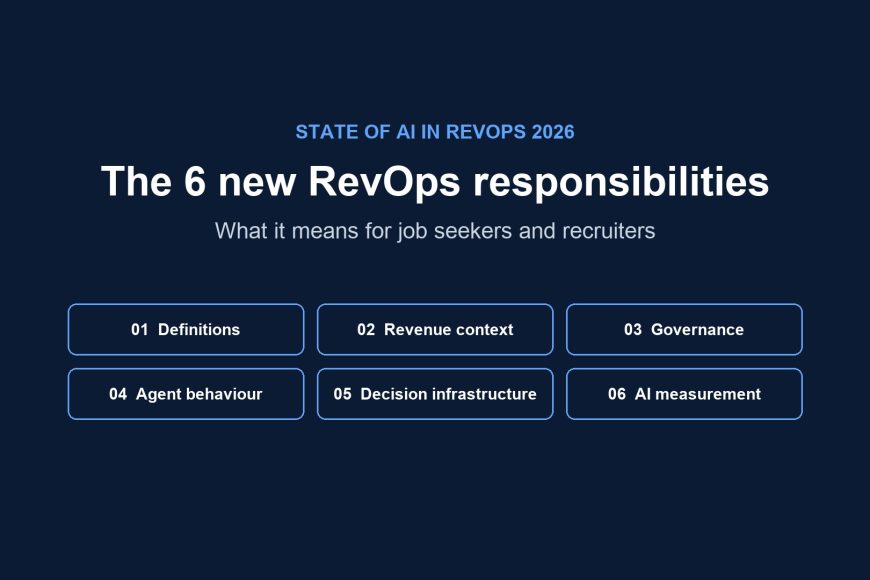
Quick answer: The 2026 State of AI in RevOps report from RevStar and Vasco found that 97% of revenue teams are using AI, but only 26% trust its output as much as a human analyst’s. Its most useful finding for hiring is a list of six responsibilities RevOps now owns on top of the old ones: definitions, revenue context, governance, agent behaviour, decision infrastructure and AI measurement. Job seekers should show proof of that work on their resumes. Recruiters should write it into job descriptions and interview loops.
RevOps job descriptions still read like it’s 2022: “own CRM hygiene, build reports, support pipeline reviews.” That work hasn’t gone away. But revenue leaders are now asking their ops teams for something different, and the gap between what job posts say and what the job actually is keeps getting wider.
The State of AI in RevOps 2026 report, published on 28 September 2026 by Vasco and the RevStar community, puts that gap on paper. Below I break down what it found, what it means for people looking for RevOps jobs, what it means for the people hiring them, and a practical to-do list for each group.
What is the 2026 State of AI in RevOps report?
It’s a peer survey of 39 revenue professionals, run between 24 August and 17 September 2026, followed by interviews with seven practitioners and advisers: Kyle Norton (former CRO, Owner), Cliff Simon (Polaris), Sam Slater (Concept3D), Anthony Enrico (LeanScale), Yasmine de Aranda and Dr. Dan Patterson (Winning by Design), and Guillaume Jacquet (Vasco).
Who answered matters if you’re using this for career decisions. Of the 39 respondents, 17 work in Sales or Revenue Operations and 12 lead RevOps at Director level or above. The rest are founders, fractional consultants and single respondents from CRO, Marketing Ops and CS Ops roles. 44% work at companies with 51–200 employees, and 31% report $100M+ ARR.
Two caveats the report states itself. With 39 people, one answer moves a percentage by about 2.6 points, so every finding is directional, not statistically representative. And Vasco sells a product in this space, so the conclusions point toward the problem Vasco solves. Read it as a practitioner view from people doing the work. It’s still the most specific picture I’ve seen of how the RevOps job is changing because of AI.
What are the key findings for RevOps careers?
| Finding | Number | Why it matters for hiring |
|---|---|---|
| Teams experimenting with AI or further along | 97% | “Uses AI” no longer sets a candidate apart |
| Trust AI output as much as a human analyst’s | 26% | Trust is the scarce skill, not usage |
| Biggest source of distrust is sources, definitions or conflicting tools | 62% | The problem is meaning, and RevOps owns meaning |
| Teams with live AI that correct a quarter or more of its output | 56% | Validation is now part of the weekly job |
| Spend four or more hours a week validating AI output | 26% | Hidden workload that rarely appears in job scopes |
| Rate their CRM clean enough for an agent to act unreviewed | 18% | Data foundations still come first |
| No clear owner for a wrong AI-generated number | 50% | An open accountability seat that someone will fill |
| Say RevOps’ strategic influence increased in the past year | 51% | The function is moving closer to decisions |
| Confident AI work is improving business outcomes | 38% | Proving ROI is a hiring signal |
The report sums it up in one line: “AI got the promotion before it passed probation.” Teams adopted AI quickly. The definitions, systems and governance that would let anyone trust it came later, or haven’t come yet. That catch-up work is landing on RevOps.
What are the six new RevOps responsibilities?
The report has a “Then and now” page. Then, RevOps owned four things: CRM hygiene, reporting, data requests and pipeline inspection. Now it owns all of that, plus six more. Here’s how I’d translate each one into language for a resume or a job post.
| New responsibility | What it means in practice | How it reads in a job description |
|---|---|---|
| 1. Definitions | Writing down what MQL, ICP, created pipeline, churn and NRR mean, with sources and filters, and getting Marketing, Sales and Finance to sign off | “Own the metric dictionary and get cross-functional sign-off on core revenue definitions” |
| 2. Revenue context | Making sure systems know which record is the real account, which plan and targets apply, and what happened historically | “Maintain a single resolved account view across CRM, billing, product and support data” |
| 3. Governance | Deciding which fields count as true, who can change a definition, and who signs off when rules change | “Set and enforce data and AI governance rules, including field ownership and change control” |
| 4. Agent behaviour | Setting what an AI agent may read, write and do, and how much it can do without review | “Define permissions, guardrails and review thresholds for AI agents in the GTM stack” |
| 5. Decision infrastructure | Making any number traceable back to its source, definition and owner before it reaches a board deck | “Build traceable reporting so every leadership metric has a documented source and owner” |
| 6. AI measurement | Tracking whether AI changed conversion, stage velocity, retention or revenue per employee, not just whether people used it | “Measure AI impact on conversion, velocity and revenue per employee” |
Sam Slater, Senior Director of Revenue Operations at Concept3D, describes the core of it in the report: “It cannot guess. It has to know this is the field. This field is locked.” The report adds: “The CRM still needs cleaning. The new job is deciding which of its fields an agent is allowed to believe.”
Why does this change RevOps hiring in 2026?
The work moved from maintaining systems to governing them
Dr. Dan Patterson puts it this way in the report: “The office of RevOps is moving, and should move more towards the office of governance.” Half of respondents say RevOps gained influence over the past year (18% significantly, 33% somewhat). But 13% say it lost influence, so this doesn’t happen automatically.
Kyle Norton sees two paths. RevOps leaders who adopt AI do the work of several people. Those who lag risk having the function absorbed by other teams. That split will show up in hiring: some companies will hire RevOps people to run AI strategy, and others will quietly fold RevOps into Finance, Data or IT.
Companies expected agent builders and got governance leaders
Anthony Enrico (LeanScale) says he expected demand for agent builders. What he saw instead was heads of RevOps being asked to lead AI strategy, with some moving into COO and CRO seats. His rule of thumb: getting an agent right is “ninety percent data model, ten percent agent.” So a candidate who can build a slick agent in an afternoon is worth less than one who can make the agent’s inputs trustworthy.
The “validation tax” is real, unpaid work
The report calls the time spent checking AI output the validation tax. 46% of respondents spend one to three hours a week on it, 26% spend four hours or more, and another 26% don’t track the time at all. Only 1 in 10 say the model’s reasoning is the main reason they check. The causes sit below the model: messy data (36%), caution or policy (21%), lack of training (15%) and no review process (13%).
Sam Slater explains why leaders miss this cost: “It’s reduced time from a leader’s perspective.” A task that used to be a whole job became a few hours of checking, and those hours don’t show up in headcount planning. If you’re scoping a role, they should.
Accountability is an open seat
When an AI-generated number is wrong, 29% of respondents say accountability hasn’t been defined and 21% say nobody formally owns it. Only 26% name RevOps. At $100M+ ARR it’s worse: 9 of 12 respondents said undefined or no one. An open accountability gap at large companies is a hiring opportunity for anyone who can credibly fill it.
Where does AI actually work in revenue operations today?
This matters for job seekers deciding what to learn first, and for hiring managers deciding what to expect from a new hire in the first 90 days. The report compared which use cases deliver the most value against which ones stalled or were rolled back:
| Use case | Delivers most value | Stalled or rolled back |
|---|---|---|
| Account / lead research | 56% | 10% |
| Reporting / board decks | 44% | 23% |
| Rep coaching | 21% | 26% |
| Customer health | 18% | 15% |
| Pipeline review | 18% | 26% |
| Forecasting | 10% | 31% |
| CRM data hygiene | 10% | 36% |
The report’s explanation: “AI works where the definition is firm. It stalls where the definition is up for debate.” Research and reporting work today. Forecasting and CRM hygiene sit closest to the revenue number, and stalls there outnumber wins three or four to one. Fixing that is RevOps work, which is the point of the six new responsibilities.
What should RevOps job seekers do now?
Practical actions, in rough order of effort.
- Rewrite your resume around the six responsibilities. Swap tool lists for outcomes. “Administered HubSpot” says little. “Wrote and got Finance sign-off on the company’s pipeline definition, which removed a recurring end-of-year reconciliation” shows definitions, governance and decision infrastructure in one line.
- Build a “metric passport” as a portfolio piece. The report shows one for Created pipeline: where it comes from (system, object, field), what it means (filters, stages, exclusions such as renewals) and who stands behind it (owner, review cadence). Make one or two for metrics you’ve owned, anonymised, and bring them to interviews. It’s concrete proof you can do the work most teams haven’t done yet.
- Keep a validation log for ten AI outputs. The report suggests noting where each correction started: data, definition or model. Do it in your current job. In an interview, “I tracked our AI errors and 7 of 10 came from an undefined field, so I fixed that first” beats “I’m comfortable with AI tools.”
- Get hands-on with the tools. Kyle Norton’s warning for executives applies to everyone: if you’re not in the tools yourself, you’ll struggle to lead the change. Build one small agent on a use case that works today, like account research or a weekly reporting summary, and write up what broke.
- Learn to explain “autonomy in proportion to consequence.” That’s Sam Slater’s rule after a Concept3D agent recommended 75 calls to a dead number, because a rep had labelled the contact “Gatekeeper” instead of “bad number.” Being able to say which actions an agent can take alone and which need review is a senior-level skill.
- Talk in business metrics. Only 38% of respondents are confident AI work is improving outcomes. Candidates who frame impact in conversion, stage velocity, retention and revenue per employee stand out. Anthony Enrico’s example: on a $20M plan, moving conversion from 20% to 21% “could mean an additional million dollars.”
- Interview the employer on governance. Ask: “Who answers for an AI-generated number that turns out to be wrong?”, “Is pipeline defined in writing, and who signed it?” and “How many hours a week does the team spend checking AI output?” The answers tell you whether you’re walking into a strategy role or a cleanup role with a strategy title.
- Target the accountability gap. My read of the ownership data (not a claim the report makes): larger companies with no named owner for AI numbers are where a governance-minded RevOps hire has the most room to make an impact. Position yourself as the person who closes that gap.
If you’re earlier in your career, our analysis of 1,890 RevOps job postings shows where the hiring volume sits. For AI-specific roles, see AIRops in 2026.
What should recruiters and hiring managers do now?
- Add the six responsibilities to your job descriptions. Most RevOps job posts still list only the “then” column. If the role will govern AI, say so. Candidates who can do this work look for it in the posting.
- Screen for definition work, not tool lists. Every applicant lists Salesforce or HubSpot. Ask for a specific metric they defined, who signed off, and what changed afterwards.
- Use the “four pipeline numbers” case. The report’s illustration: one CRM, four answers. Marketing says $6.1M (all opportunities created), RevOps $4.4M (ACV above zero and segment populated), Finance $2.9M (weighted by stage), and the CEO $5.2M (the 2023 board-deck definition). Give a candidate those four numbers and ask how they’d get to one. It tests definitions, stakeholder management and governance in 20 minutes.
- Write accountability into the role. Half of teams have no clear owner for a wrong AI number. If this hire will own it, say so in the job description and give them the authority to go with it.
- Scope the validation tax into headcount. If a quarter of teams spend four or more hours a week checking AI output, a plan that assumes AI has already freed up capacity will under-hire. Ask the team how much time they spend checking before you approve a smaller team.
- Level the role correctly. Governance work sits closer to the decision. The report notes that heads of RevOps are being asked to lead AI strategy, and some are moving into COO and CRO seats. Pricing a governance-heavy role at an “admin” band will get you admin-level candidates.
- Put business metrics on the 90-day scorecard. Judge the hire on what changed (fewer reconciliations, faster diagnostics, conversion or velocity movement), not on AI usage dashboards. Enrico’s team cut a diagnostic from weeks to 48 hours by writing the client’s definitions down first. That’s the kind of result to ask for.
Sample job description block you can copy
Revenue governance and AI (in addition to core RevOps responsibilities)
- Own the revenue metric dictionary: written definitions, sources and owners for pipeline, MQL, ICP, churn and NRR, signed off by Marketing, Sales and Finance.
- Maintain one resolved account record across CRM, billing, product and support data.
- Set governance rules for which fields AI tools and agents can treat as true, and manage changes to them.
- Define what AI agents can read, write and do without review, scaled to the consequence of a mistake.
- Make every leadership-facing number traceable to its source, definition and owner.
- Measure AI impact on conversion, stage velocity, retention and revenue per employee.
Interview questions mapped to the report’s six moves
The report closes with six moves teams make to get from AI they check to AI they can hand work to. Each one works as an interview question:
- Define: “If the CEO asked for pipeline tomorrow, how would you make sure everyone calculates it the same way?”
- Resolve: “Tell me about a time two systems disagreed on the same customer. Which one did you make authoritative, and why?”
- Govern: “Who should be allowed to change a metric definition, and who has to agree?”
- Trace: “When someone challenges a forecast, where do you go first to prove it?”
- Measure: “How would you show an AI agent changed something in the business, not just that people used it?”
- Delegate: “What’s the lowest-risk action you’d let an agent take on its own next month?”
Ready to hire? Post a RevOps job where RevOps professionals are already looking.
Frequently asked questions
What are the six new RevOps responsibilities in 2026?
According to the 2026 State of AI in RevOps report by RevStar and Vasco, RevOps now owns definitions, revenue context, governance, agent behaviour, decision infrastructure and AI measurement. These sit on top of the four traditional responsibilities: CRM hygiene, reporting, data requests and pipeline inspection.
Will AI replace RevOps jobs?
The report points the other way. 51% of respondents say RevOps’ strategic influence grew in the past year, and heads of RevOps are being asked to lead AI strategy. The risk sits with RevOps teams that don’t adopt AI: Kyle Norton warns those functions may be absorbed by other teams. AI is taking over research and reporting tasks. Governing the data and rules AI runs on is becoming the job.
What skills do RevOps job seekers need for AI in 2026?
Writing and getting sign-off on metric definitions, resolving conflicting records across systems, setting governance and agent permissions, making numbers traceable, and measuring AI impact in business metrics. Hands-on experience building and testing at least one AI workflow also helps.
What should a RevOps job description include in 2026?
The core RevOps duties plus explicit ownership of the metric dictionary, account resolution, data and AI governance, agent permissions, traceable reporting and AI impact measurement. It should also say who is accountable for AI-generated numbers, since 50% of teams in the report have no clear owner.
What is the “validation tax” in RevOps?
It’s the report’s term for the time spent checking AI output before anyone can use it. 46% of respondents spend one to three hours a week on it, 26% spend four or more, and 26% don’t track it. 56% of teams with live AI correct a quarter or more of what it produces.
Who should own AI-generated revenue numbers?
The experts in the report agree that context and definitions should sit with the team that sees the whole customer journey, which is usually RevOps. Today only 26% of respondents name RevOps as accountable, 29% haven’t defined it and 21% say nobody formally owns it.
Which AI use cases work best in revenue operations?
Account and lead research (56% say it delivers the most value) and reporting or board decks (44%). Forecasting and CRM data hygiene stall most often, at 31% and 36% stalled or rolled back, because those depend on definitions teams still argue about.
How reliable is the State of AI in RevOps 2026 report?
It’s a directional practitioner survey of 39 revenue professionals, most of them RevOps practitioners or leaders, run in August and September 2026. The authors say it isn’t statistically representative and that Vasco, a co-producer, sells a product in this area. Use it to see where the job is heading, not as a market-wide benchmark.
Sources
- State of AI in RevOps 2026 (PDF), RevStar and Vasco, published 28 September 2026. Survey of 39 revenue professionals (24 August – 17 September 2026) plus expert interviews. Quotes and figures in this article come from the report.
- Vasco, “The trust gap in action” case study, referenced in the report.
- RevOpsCareers, The 2026 RevOps Career Guide.





Follow us on social media